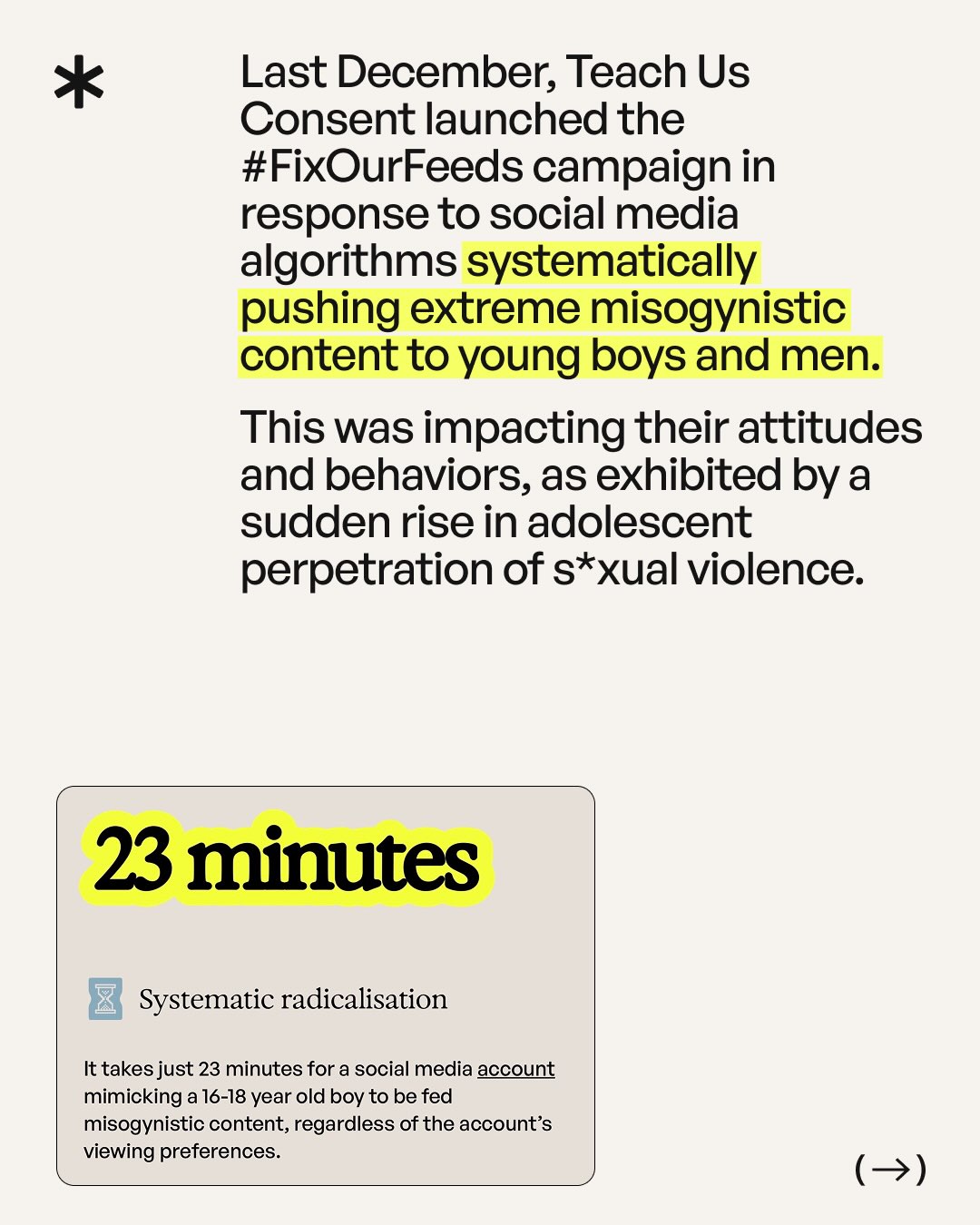
Social media algorithms are flooding young men’s feeds with radical misogynistic content, inciting real-world harm.
We called on the Australian Government to act, and introduce an opt-in feature for social media algorithms so we can bring affirmative and ongoing consent to our screens. 15,000 Australians signed our Open Letter, and in early September the Government heard our calls and committed to the #FixOurFeeds campaign.




%20(1).jpg)
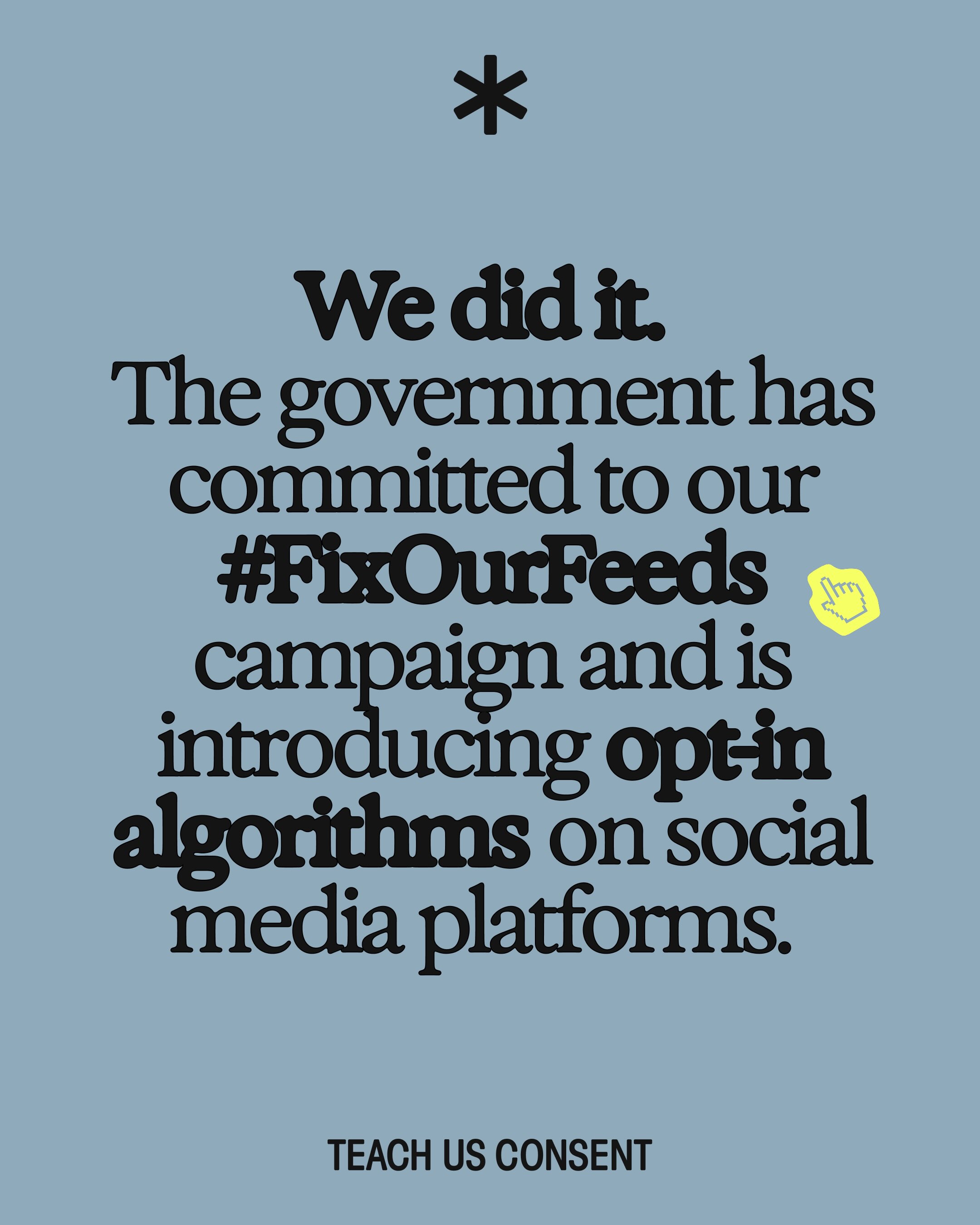



We did it.
This is one piece of a much bigger picture. Ending gender-based violence requires a broad and interconnected range of solutions, and we'll keep pushing for the reforms needed. For now: thank you.
World-leading algorithm reforms



Add your name to the open letter
Our open letter to the Prime Minister
Dear Prime Minister Anthony Albanese,
The social media feeds that once connected us are now tearing us apart.
The algorithms that curate our feeds are designed to keep us scrolling. They prioritise content that provokes the strongest emotional reactions; outrage, validation, fear, arousal and anger drive ‘successful’ posts. In turn, our feeds have become fertile ground for extreme, misogynistic content.
Young men and boys are being pulled into misogynistic spaces, seeking community and belonging. Studies show that dummy accounts created to imitate 16–18-year-old boys were fed extreme “manosphere” content within minutes.
Attitudes common in the “manosphere” - like undermining women' s independence and the excusing of men’s violence - are strongly linked with support for violence against women.
The consequences are severe. Australia’s National Crisis of gender-based violence is worsening; teenage boys have overtaken adult men as the most likely perpetrators of child sexual abuse. Image-based abuse is at record highs. Extremist groups use misogynistic content for recruitment and teachers have reported rising misogyny in schools across the nation.
Men and boys aren’t benefitting from this either - it's isolating them. They're experiencing higher rates of social disconnection than ever.
But the Government can still change the story. With the Online Safety Act in review, the time to act is now.
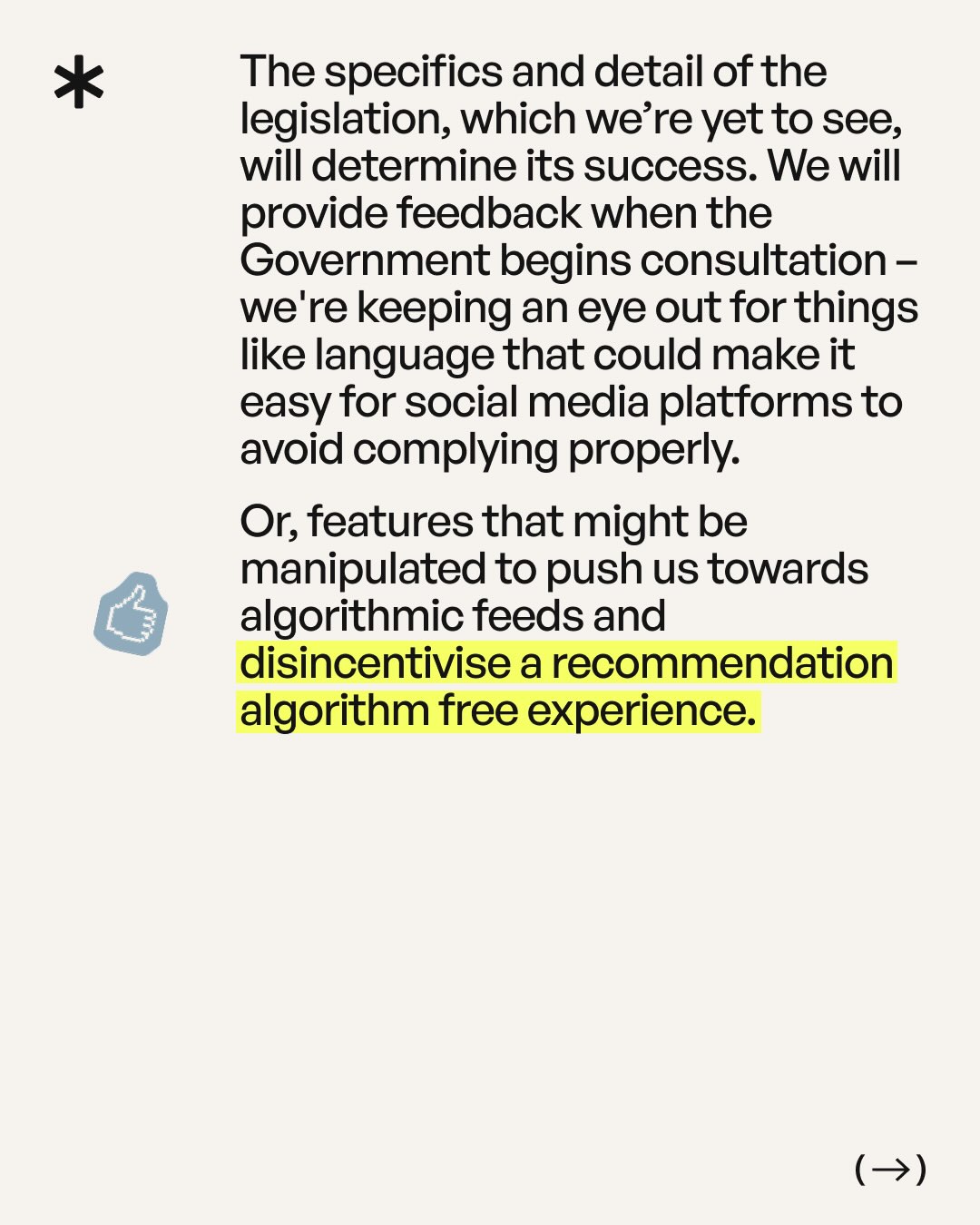
We urge the Government to require social media platforms to offer an option to “opt-in” to algorithms, giving us the autonomy to turn our algorithms on and off. This is about informed and affirmative consent: control over our data and our feeds. The European Union has paved the way with an “opt-out” policy but this would be a world first, bringing genuine consent to our online experiences.
This single intervention would not only help prevent gender-based violence and the mainstreaming of radicalised misogyny, but also help people vulnerable to eating disorders, self harm and prevent exposure to racism, homophobia, mis & disinformation and other harmful content. Or, it could just be a tool for people wanting to spend less time on socials.
Australia was applauded at the United Nations General Assembly for its Social Media Minimum Age Bill. We know that’s only the first step.
Let’s continue that momentum to protect people against online harms with bold legislation that gives Australians real choice.
Signed by:
Chanel Contos, CEO of Teach Us Consent
Dr Zac Seidler, Global Director of Movember
Jess Hill, Industry Professor at the University of Technology Sydney
Malcolm Turnbull AC, Former Primer Minister of Australia
Sanna Marin, Former Prime Minister of Finland
Jennifer Robinson, Human Rights Barrister and Author
Yanis Varoufakis, Greek Economist & Politician
Michele Oneil, President of the Australian Council of Trade Unions
Dr Anna Cody, ASex Discrimination Commissioner of Australia
Georgie Harman, CEO of Beyond Blue
Jim Hungerford, CEO of the Butterfly Foundation
Rabbi Yossi Friedman
Anne Hollonds AO
Dr Hannah Tonkin, NSW Women’s Safety Commissioner
Daniel Principe, Youth Advocate and Educator
Dr Billy Garvey, Developmental Paediatrician and Author
Ben Vasiliou, CEO of The Man Cave
Hannah Ferguson, CEO of Cheek Media
Nicole Yade, CEO of Women’s and Girls’ Emergency Centre
Patrick Darcy, CEO of Batyr
ReachOut Australia, Mental Health Organisation
Professor Michael Flood, Queensland University of Technology
Professor Ben Mathews, Queensland University of Technology
Melissa Abu-Gazaleh, Founder and Managing Director of Top Blokes
Professor Nicholas Carah, Director of Centre for Digital Cultures and Societies, University of Queensland
Michelle Ryan, Director of Global Institute for Women's Leadership
Natalie Kyriacou OAM, Environmentalist & Social Activist
Wendy McCarthy AC, Businesswoman, Activist and Author
Tarang Chawla, Award-winning Keynote Speaker, Writer and Activist
Dr Joy Townsend, CEO of Learning Consent
Benjamin Law, Writer and Broadcaster
Dr Joanne Gray, University of Sydney
Zahra Al Hilaly, UN Women’s Generation Equality Youth Task Force
Grace Forrest, Human Rights Advocate, Australian UN Goodwill Ambassador and Founder of Walk Free
Abbie Chatfield, Television Host, Radio Presenter and Podcaster
Blake Pavey, Comedian and Content Creator
Zoë Foster Blake, Author and Entrepreneur
Gina Martin, Gender Equality Activist
Harry Garside, Professional Boxer and Advocate
Karen Bentley, CEO of WESNET
Charlotte Mortlock, Executive Director Hilma's Network
Yvonne Weldon AM, NSW Aboriginal Woman of the Year, Councillor and DVNSW Board Member
CEO Susanne Legena and Deputy CEO Hayley Cull, Plan International Australia
Maree Crabbe, Director at It’s Time We Talked
Tom Sulston, Digital Rights Watch Australia
Jack Toohey, Author and Activist
Michele O'Neil, President of the Australian Council of Trade Unions
Sara Wahedi, CEO and Founder of Civaam
Meredith Turnbull, Principal at VOX FEMINA
Greg Attwells, Managing Director 36 months
Oliver White, National Youth Project Manager NAPCAN
Ben Oquist, DPG Advisory Solutions
Lucinda Price (AKA Froomes), Writer and Comedian
Georgia Grace, Certified Sex and Relationships Practitioner, Somatic Therapist and Author
Angelique Wan, CEO Consent Labs
Jane Larkin, Educator and Filmmaker
Paige Campbell, Co- Founder and CEO Tomorrow Man & Tomorrow Woman
Tom Harkin, Co-Founder and Creative Director Tomorrow Man & Tomorrow Woman
Thurkka Jeyakumar, Amnesty International Australia National Youth Representative
Allegra Spender, Federal Member for Wentworth
Sarah Hanson-Young, Senator for South Australia
Dr Ashna Basu, Royal Australian and New Zealand College of Psychiatrists
Dr Pramudie Gunaratne, CEO Australian Society of Psychiatrists
Craig Foster AM, Human Rights Advocate and Former Captain of the Socceroos
Matt Basely, Radio and TV Presenter
Courtney Act, Drag Queen & Singer
Thomas Mayo, Human Rights Advocate & Author
Jessica Rowe, Podcast Host and Author
Noemie Fox, Australian Olympic Champion
Isabelle Reinecke, Grata Fund
Konrad Benjamin, Punter's Politics
Nicolette Boele, Federal Member for Bradfield
Shaynna Blaze, Interior Designer and TV Personality
Zali Steggal, Federal MP
Harrison James, Survivor Advocate
Kate Chaney, Federal Member for Curton
Kylie Moore-Gilbert, Author and Academic
Ed Coper, Author and Executive Director of Center of Impact Communications
Christine Holgate, Australian Business Executive
Georgie Dent, CEO at The Parenthood
Andrew Wilkie, TAS Member of Parliament
Georgie Purcell, VIC Member of Parliament
Yasmin Poole, Youth Advocate and Rhodes Scholar
Dr Sophie Scamps, Federal Member for Mackellar
Dr Helen Haines, Federal Member for Indi
Dr Monique Ryan, Federal Member for Kooyong
Tanya Hosh, Social Activist and Australian Business Executive
Tilly Odly Black, Comedian, Actor and Writer
Hugh van Cuylenberg, Josh van Cuylenberg, Ryan Shelton,The Imperfects
Kate Fitzgibbon & Matt Tyler, Jesuit Social Services
Virginia Haussegger, Journalist & Gender Equality Advocate
Dr Anne Summers AO, Journalist, Author & Feminist Activist
Leesa Waters, NAPCAN CEO

Got questions? We’ve got answers.
.jpg)

.jpg)
.jpg)

.jpg)

The scroll ends here. You’ve consumed all the factual information you need to know.